
Hello there. I have been working as a business analyst for over a decade. Throughout my career, I have reviewed countless resumes, interviewed many candidates, and mentored junior team members. One question comes up more often than any other. People always ask me which certification they should get to advance their business analysis career.
The International Institute of Business Analysis (IIBA) offers three core certifications. These are the ECBA, the CCBA, and the CBAP. Each one targets a different stage of your career. However, picking the right one can feel confusing. If you aim too high, you will waste time and money on an exam you cannot pass. If you aim too low, you might not get the career boost you desire.
Today, I want to clear up this confusion. I will break down the differences between the ECBA, CCBA, and CBAP. By the end of this guide, you will know exactly how to choose the right Business Analyst certifications for your current experience level.
Why Pursue IIBA Business Analyst Certifications?
Before we look at the specific options, we should discuss why you need a certification in the first place. You might be wondering if the effort is truly worth it. In my experience, the answer is a resounding yes.
First, certifications help your resume stand out to recruiters. The job market is highly competitive. Hiring managers often use certifications as a quick filter to find serious candidates. Second, preparing for these exams forces you to learn the BABOK Guide. The Business Analysis Body of Knowledge (BABOK) is the global standard for our profession. Knowing this framework makes you a better, more structured problem solver.
Finally, certified professionals generally earn higher salaries. Employers value the proven skills and dedication that come with IIBA certifications. Whether you are an entry-level business analyst or aiming for senior BA roles, the right credential will open new doors for you.
Understanding the IIBA Certification Framework
The IIBA created a multi-level framework to match the natural career path of a business analyst. Let us take a detailed look at each of the three main levels.
Level 1: ECBA (Entry Certificate in Business Analysis)
The ECBA is the foundation level. It is designed specifically for beginners. If you recently graduated from college or want to transition into a business analysis career from another field, this is your starting point.
Who is it for?
- Fresh graduates looking for their first job.
- Professionals switching from roles like QA, development, or sales.
- Project managers who want to understand business analysis principles.
Prerequisites
The best part about the ECBA is that it does not require any prior work experience. You do not need to show thousands of hours of project work. However, you do need to complete 21 Professional Development (PD) hours in the last four years. You can get these hours by taking approved training courses.
Exam Focus
The ECBA exam tests your basic understanding of the BABOK Guide. It checks if you know the terminology, the core concepts, and the basic techniques. It does not expect you to know how to navigate complex project politics. It just wants to ensure you have a solid theoretical foundation.
Level 2: CCBA (Certification of Capability in Business Analysis)

The CCBA is the middle tier. It is meant for professionals who already have some hands-on experience but are not quite senior level yet. When I was three years into my career, I found the CCBA to be a great way to validate the skills I had learned on the job.
Who is it for?
- Mid-level business analysts.
- Product owners with some BA responsibilities.
- Hybrid professionals like hybrid project managers or technical BAs.
Prerequisites
To apply for the CCBA, you must prove your experience. You need a minimum of 3,750 hours of business analysis work experience in the last seven years. Out of those hours, you must have at least 900 hours in two different BABOK knowledge areas or 500 hours in four different knowledge areas. You also need 21 Professional Development hours in the last four years.
Exam Focus
The CCBA exam is harder than the ECBA. It moves beyond simple definitions. The questions are scenario-based. They test your ability to apply the BABOK principles to real world situations. You have to show that you can choose the right technique for a specific problem.
Level 3: CBAP (Certified Business Analysis Professional)
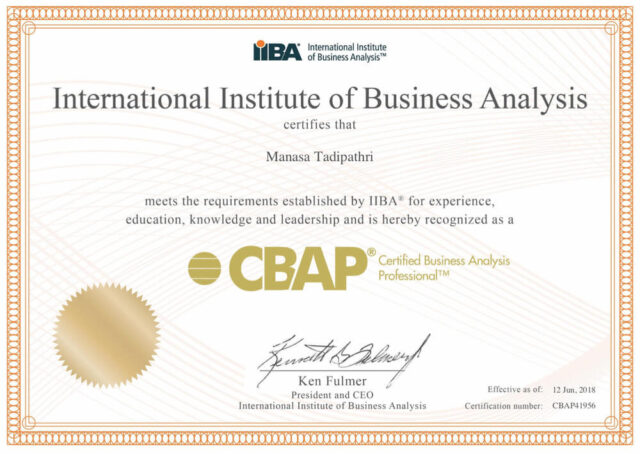
The CBAP is the gold standard of Business Analyst certifications. I remember studying for my CBAP. It was a rigorous process, but earning it completely changed the trajectory of my career. It is designed for experts with extensive experience.
Who is it for?
- Senior business analysts.
- Lead BAs and BA Managers.
- Experienced consultants.
Prerequisites
The requirements here are very strict. You need a massive 7,500 hours of business analysis work experience in the last ten years. You also need a minimum of 900 hours in four of the six BABOK knowledge areas. In addition, you must complete 35 Professional Development hours in the last four years and provide professional references.
Exam Focus
The CBAP exam is heavily based on case studies. You will read long scenarios and answer multiple questions about them. It tests your ability to synthesize information, analyze complex enterprise problems, and recommend strategic solutions. It requires a deep, intuitive understanding of the entire BABOK Guide.
ECBA vs. CCBA vs. CBAP – A Quick Comparison

To make things simple, here is a quick summary of the key differences.
Work Experience Required:
- ECBA: Zero hours.
- CCBA: 3,750 hours.
- CBAP: 7,500 hours.
Training Hours Required:
- ECBA: 21 hours.
- CCBA: 21 hours.
- CBAP: 35 hours.
Difficulty Level:
- ECBA: Easy to Medium (Knowledge-based).
- CCBA: Medium to Hard (Scenario-based).
- CBAP: Very Hard (Case study-based).
How to Choose the Right Business Analyst Certification for You

Now that you understand the differences, how do you make your final choice? The decision should rely entirely on your documented work experience and your immediate career goals. Do not try to skip steps if you do not have the experience. The application process is audited, and the exams are designed to weed out those who lack practical knowledge.
Advice for Beginners
If you have less than two years of experience, your path is very clear. Go for the ECBA. It will give you a huge advantage over other entry-level candidates. It shows hiring managers that you are serious about the profession and that you already understand the global standards.
Advice for Mid-Level Professionals
If you have between two and five years of experience, you should aim for the CCBA. Some people try to wait until they qualify for the CBAP. I advise against this. Waiting means you miss out on years of recognition and potential salary bumps. Earning your CCBA now proves your capability and builds your confidence for the future.
Advice for Senior Professionals
If you have over five years of heavy, dedicated business analysis experience, the CBAP is your target. It will help you land senior BA roles, lead positions, or high-paying consulting jobs. Prepare thoroughly, because relying on experience alone is not enough. You must understand how your experience maps to the specific language of the BABOK Guide.
Getting the Right Training
No matter which path you choose, proper preparation is the key to passing your exam. You cannot just skim a book and expect to pass. The IIBA exams are tricky. You need structured training that not only grants you the required Professional Development hours but also teaches you how to think like the exam creators.
I highly recommend finding a trusted education provider. A good training partner will offer study guides, question banks, and expert guidance. If you are ready to take the next step in your career, you can explore excellent Business Analyst certification programs that cater to all three IIBA levels. Finding a comprehensive course is the smartest investment you can make for your exam preparation.
Final Thoughts from a Senior BA
Building a successful business analysis career takes time, patience, and continuous learning. Certifications are not a magic wand, but they are powerful tools. They give you a structured way to learn, they validate your hard work, and they give employers confidence in your abilities.
Do not let the complexity of the BABOK Guide intimidate you. Start where you are. If you are new, embrace the ECBA. If you have some miles under your belt, conquer the CCBA. And if you are a seasoned veteran, go claim your CBAP. Choose the right goal for your current experience level, put in the study time, and watch your career grow. Good luck on your certification journey.